

Express F In Standard Form
5.2: Quadratic Functions
- Page ID
- 15067
Learning Objectives
- Recognize characteristics of parabolas.
- Sympathize how the graph of a parabola is related to its quadratic function.
- Determine a quadratic part's minimum or maximum value.
- Solve problems involving a quadratic office'due south minimum or maximum value.
Curved antennas, such as the ones shown in Effigy \(\PageIndex{1}\), are commonly used to focus microwaves and radio waves to transmit idiot box and phone signals, too as satellite and spacecraft communication. The cross-section of the antenna is in the shape of a parabola, which can exist described by a quadratic function.
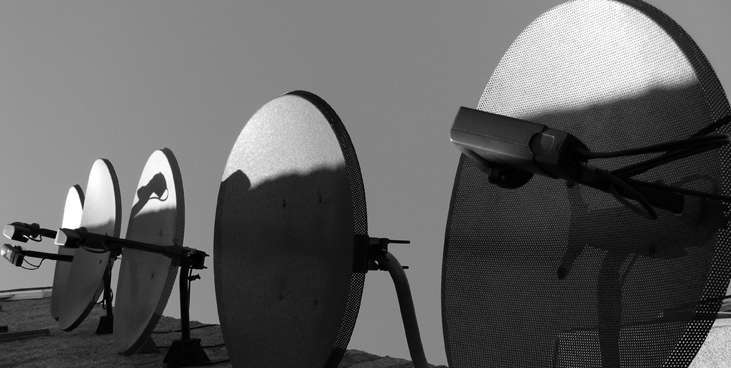
Effigy \(\PageIndex{one}\): An array of satellite dishes. (credit: Matthew Colvin de Valle, Flickr)
In this section, nosotros volition investigate quadratic functions, which oftentimes model problems involving area and projectile motion. Working with quadratic functions can be less complex than working with higher degree functions, so they provide a good opportunity for a detailed report of role beliefs.
Recognizing Characteristics of Parabolas
The graph of a quadratic office is a U-shaped bend called a parabola. One important feature of the graph is that it has an extreme point, chosen the vertex. If the parabola opens up, the vertex represents the lowest point on the graph, or the minimum value of the quadratic function. If the parabola opens downward, the vertex represents the highest signal on the graph, or the maximum value. In either case, the vertex is a turning point on the graph. The graph is also symmetric with a vertical line drawn through the vertex, called the axis of symmetry. These features are illustrated in Figure \(\PageIndex{ii}\).
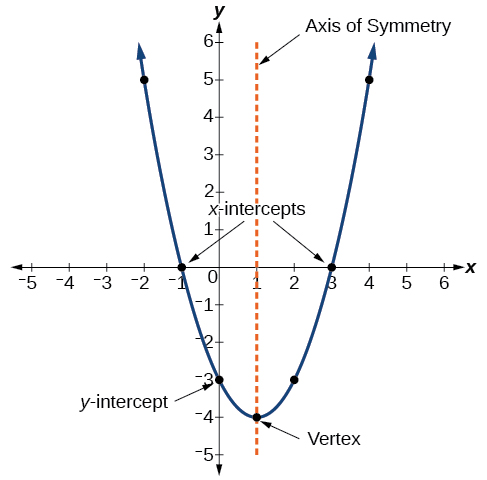
The y-intercept is the betoken at which the parabola crosses the \(y\)-centrality. The ten-intercepts are the points at which the parabola crosses the \(x\)-axis. If they exist, the ten-intercepts represent the zeros, or roots, of the quadratic part, the values of \(x\) at which \(y=0\).
Instance \(\PageIndex{1}\): Identifying the Characteristics of a Parabola
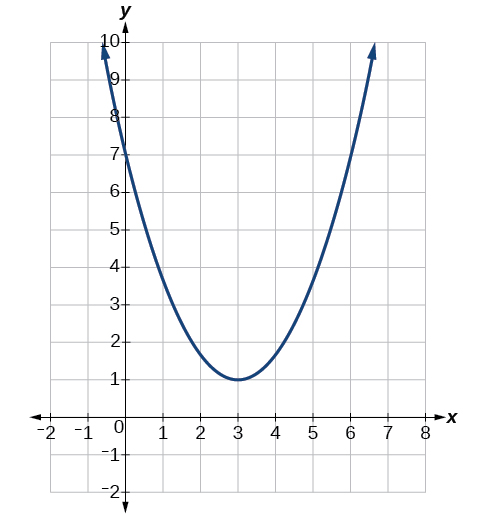
Make up one's mind the vertex, axis of symmetry, zeros, and y-intercept of the parabola shown in Effigy \(\PageIndex{3}\).
Solution
The vertex is the turning point of the graph. We tin can see that the vertex is at \((iii,1)\). Because this parabola opens upward, the axis of symmetry is the vertical line that intersects the parabola at the vertex. So the axis of symmetry is \(x=3\). This parabola does not cross the 10-axis, so it has no zeros. Information technology crosses the \(y\)-centrality at \((0,vii)\) and so this is the y-intercept.
The general form of a quadratic function presents the part in the course
\[f(x)=ax^2+bx+c\]
where \(a\), \(b\), and \(c\) are real numbers and \(a{\neq}0\). If \(a>0\), the parabola opens upwardly. If \(a<0\), the parabola opens downward. Nosotros tin use the general grade of a parabola to find the equation for the centrality of symmetry.
The axis of symmetry is divers by \(x=−\frac{b}{2a}\). If we use the quadratic formula, \(x=\frac{−b{\pm}\sqrt{b^ii−4ac}}{2a}\), to solve \(ax^2+bx+c=0\) for the x-intercepts, or zeros, we observe the value of \(ten\) halfway between them is e'er \(x=−\frac{b}{2a}\), the equation for the centrality of symmetry.
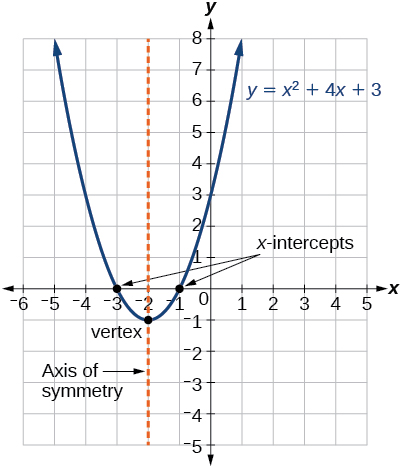
Effigy \(\PageIndex{4}\) represents the graph of the quadratic function written in general form as \(y=10^2+4x+3\). In this form, \(a=1\), \(b=4\), and \(c=3\). Because \(a>0\), the parabola opens upward. The axis of symmetry is \(x=−\frac{4}{two(one)}=−2\). This also makes sense because we can see from the graph that the vertical line \(10=−2\) divides the graph in half. The vertex ever occurs along the axis of symmetry. For a parabola that opens upward, the vertex occurs at the lowest point on the graph, in this instance, \((−2,−one)\). The x-intercepts, those points where the parabola crosses the ten-axis, occur at \((−3,0)\) and \((−1,0)\).
The standard form of a quadratic function presents the function in the form
\[f(x)=a(10−h)^ii+g\]
where \((h, grand)\) is the vertex. Because the vertex appears in the standard class of the quadratic part, this grade is besides known as the vertex form of a quadratic function.
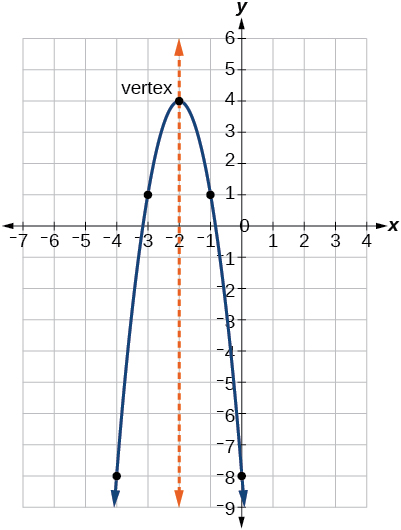
Every bit with the general class, if \(a>0\), the parabola opens upward and the vertex is a minimum. If \(a<0\), the parabola opens downward, and the vertex is a maximum. Figure \(\PageIndex{5}\) represents the graph of the quadratic function written in standard form as \(y=−iii(10+ii)^ii+4\). Since \(x–h=x+2\) in this example, \(h=–ii\). In this form, \(a=−3\), \(h=−2\), and \(k=iv\). Because \(a<0\), the parabola opens downward. The vertex is at \((−2, 4)\).
The standard form is useful for determining how the graph is transformed from the graph of \(y=x^2\). Figure \(\PageIndex{half-dozen}\) is the graph of this basic function.
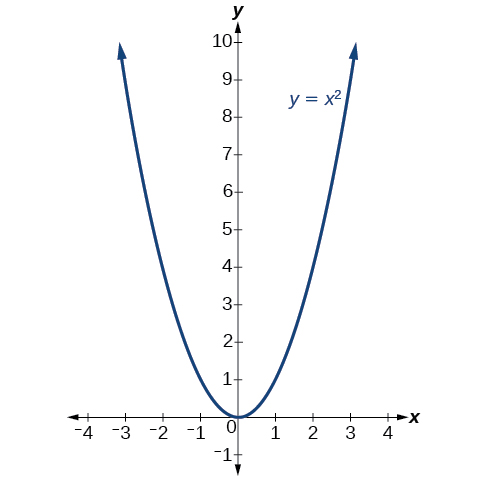
If \(g>0\), the graph shifts upward, whereas if \(m<0\), the graph shifts downward. In Figure \(\PageIndex{v}\), \(k>0\), so the graph is shifted 4 units upward. If \(h>0\), the graph shifts toward the right and if \(h<0\), the graph shifts to the left. In Figure \(\PageIndex{5}\), \(h<0\), and then the graph is shifted 2 units to the left. The magnitude of \(a\) indicates the stretch of the graph. If \(|a|>1\), the signal associated with a particular x-value shifts farther from the ten-axis, then the graph appears to go narrower, and there is a vertical stretch. But if \(|a|<one\), the bespeak associated with a particular 10-value shifts closer to the x-axis, and so the graph appears to become wider, merely in fact there is a vertical compression. In Effigy \(\PageIndex{5}\), \(|a|>1\), so the graph becomes narrower.
The standard grade and the general form are equivalent methods of describing the same function. We tin can see this past expanding out the general form and setting information technology equal to the standard form.
\[\begin{marshal*} a(10−h)^2+yard &= ax^2+bx+c \\[4pt] ax^2−2ahx+(ah^two+yard)&=ax^2+bx+c \end{align*} \]
For the linear terms to be equal, the coefficients must be equal.
\[–2ah=b \text{, so } h=−\dfrac{b}{2a}. \nonumber\]
This is the axis of symmetry we defined earlier. Setting the constant terms equal:
\[\begin{marshal*} ah^2+k&=c \\ 1000&=c−ah^two \\ &=c−a\cdot\Large(-\dfrac{b}{2a}\Big)^2 \\ &=c−\dfrac{b^two}{4a} \end{align*}\]
In exercise, though, it is usually easier to call up that \(g\) is the output value of the function when the input is \(h\), then \(f(h)=1000\).
Definitions: Forms of Quadratic Functions
A quadratic part is a function of degree two. The graph of a quadratic office is a parabola.
- The full general class of a quadratic part is \(f(x)=ax^two+bx+c\) where \(a\), \(b\), and \(c\) are existent numbers and \(a{\neq}0\).
- The standard form of a quadratic office is \(f(x)=a(x−h)^two+k\).
- The vertex \((h,k)\) is located at \[h=–\dfrac{b}{2a},\;k=f(h)=f(\dfrac{−b}{2a}).\]
HOWTO: Write a quadratic function in a general form
Given a graph of a quadratic function, write the equation of the function in general class.
- Identify the horizontal shift of the parabola; this value is \(h\). Identify the vertical shift of the parabola; this value is \(one thousand\).
- Substitute the values of the horizontal and vertical shift for \(h\) and \(k\). in the office \(f(ten)=a(x–h)^ii+one thousand\).
- Substitute the values of any point, other than the vertex, on the graph of the parabola for \(x\) and \(f(ten)\).
- Solve for the stretch cistron, \(|a|\).
- If the parabola opens up, \(a>0\). If the parabola opens down, \(a<0\) since this means the graph was reflected about the x-axis.
- Aggrandize and simplify to write in full general class.
Case \(\PageIndex{2}\): Writing the Equation of a Quadratic Function from the Graph
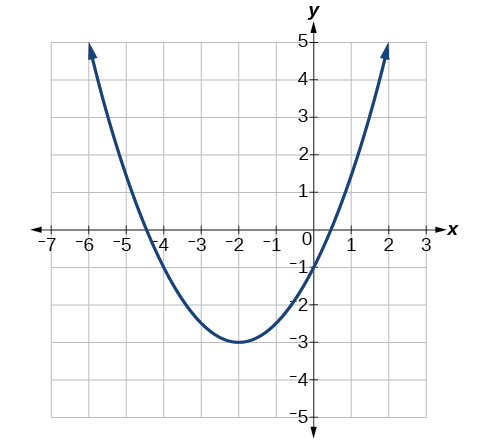
Write an equation for the quadratic function \(g\) in Figure \(\PageIndex{seven}\) as a transformation of \(f(10)=x^2\), and then expand the formula, and simplify terms to write the equation in general form.
Solution
We can see the graph of \(grand\) is the graph of \(f(x)=ten^2\) shifted to the left 2 and down 3, giving a formula in the form \(g(10)=a(x+two)^2–3\).
Substituting the coordinates of a indicate on the curve, such as \((0,−1)\), nosotros can solve for the stretch factor.
\[\brainstorm{align} −1&=a(0+ii)^2−3 \\ 2&=4a \\ a&=\dfrac{one}{2} \cease{align}\]
In standard grade, the algebraic model for this graph is \(thou(10)=\dfrac{1}{ii}(x+two)^two–3\).
To write this in general polynomial grade, we tin expand the formula and simplify terms.
\[\begin{align} one thousand(x)&=\dfrac{ane}{2}(x+ii)^2−3 \\ &=\dfrac{one}{two}(x+2)(ten+2)−3 \\ &=\dfrac{1}{2}(ten^2+4x+iv)−iii \\ &=\dfrac{1}{ii}ten^2+2x+2−3 \\ &=\dfrac{i}{ii}ten^2+2x−1 \finish{align}\]
Observe that the horizontal and vertical shifts of the basic graph of the quadratic role determine the location of the vertex of the parabola; the vertex is unaffected by stretches and compressions.
Analysis
We can cheque our piece of work using the table characteristic on a graphing utility. First enter \(\mathrm{Y1=\dfrac{1}{2}(x+2)^2−three}\). Next, select \(\mathrm{TBLSET}\), and then use \(\mathrm{TblStart=–6}\) and \(\mathrm{ΔTbl = two}\), and select \(\mathrm{Table}\). Meet Table \(\PageIndex{1}\)
| \(10\) | -6 | -4 | -2 | 0 | 2 |
|---|---|---|---|---|---|
| \(y\) | -5 | -1 | -3 | -1 | 5 |
The ordered pairs in the table correspond to points on the graph.
Do \(\PageIndex{ii}\)
A coordinate grid has been superimposed over the quadratic path of a basketball game in Figure \(\PageIndex{8}\). Observe an equation for the path of the ball. Does the shooter make the basket?
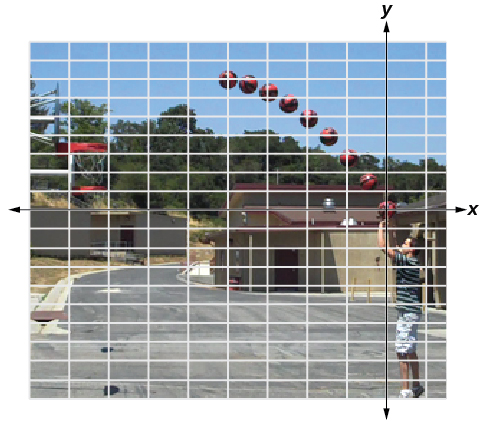
Figure \(\PageIndex{viii}\): Terminate motioned motion picture of a boy throwing a basketball game into a hoop to show the parabolic curve it makes.
(credit: modification of piece of work by Dan Meyer)
- Answer
-
The path passes through the origin and has vertex at \((−4, 7)\), and then \(h(x)=–\frac{7}{16}(x+4)^2+vii\). To make the shot, \(h(−seven.five)\) would need to be nigh four only \(h(–7.5){\approx}i.64\); he doesn't make it.
 Given a quadratic function in general class, find the vertex of the parabola.
- Identify \(a\), \(b\), and \(c\).
- Find \(h\), the x-coordinate of the vertex, by substituting \(a\) and \(b\) into \(h=–\frac{b}{2a}\).
- Find \(k\), the y-coordinate of the vertex, by evaluating \(yard=f(h)=f\Large(−\frac{b}{2a}\Big)\).
Example \(\PageIndex{three}\): Finding the Vertex of a Quadratic Function
Discover the vertex of the quadratic function \(f(ten)=2x^2–6x+7\). Rewrite the quadratic in standard form (vertex form).
Solution
The horizontal coordinate of the vertex will exist at
\[\begin{align} h&=–\dfrac{b}{2a} \\ &=-\dfrac{-6}{ii(ii)} \\ &=\dfrac{vi}{four} \\ &=\dfrac{3}{2}\cease{align}\]
The vertical coordinate of the vertex will be at
\[\brainstorm{align} k&=f(h) \\ &=f\Big(\dfrac{iii}{2}\Big) \\ &=2\Large(\dfrac{3}{ii}\Big)^ii−half dozen\Big(\dfrac{3}{ii}\Big)+seven \\ &=\dfrac{5}{2} \end{align}\]
Rewriting into standard form, the stretch factor will be the aforementioned as the \(a\) in the original quadratic.
\[f(ten)=ax^ii+bx+c \\ f(x)=2x^2−6x+7\]
Using the vertex to determine the shifts,
\[f(ten)=ii\Large(x–\dfrac{3}{2}\Large)^2+\dfrac{5}{2}\]
Analysis
One reason we may want to identify the vertex of the parabola is that this point will inform us what the maximum or minimum value of the function is, \((yard)\),and where information technology occurs, \((h)\).
Exercise \(\PageIndex{3}\)
Given the equation \(yard(10)=13+ten^2−6x\), write the equation in general form and so in standard course.
- Answer
-
\(thousand(10)=x^two−6x+13\) in general grade; \(g(ten)=(ten−3)^two+4\) in standard grade.
Finding the Domain and Range of a Quadratic Function
Whatever number tin be the input value of a quadratic office. Therefore, the domain of any quadratic function is all existent numbers. Because parabolas have a maximum or a minimum point, the range is restricted. Since the vertex of a parabola volition be either a maximum or a minimum, the range volition consist of all y-values greater than or equal to the y-coordinate at the turning point or less than or equal to the y-coordinate at the turning point, depending on whether the parabola opens up or downward.
Definition: Domain and Range of a Quadratic Function
The domain of any quadratic function is all real numbers.
The range of a quadratic function written in full general form \(f(10)=ax^ii+bx+c\) with a positive \(a\) value is \(f(x){\geq}f ( −\frac{b}{2a}\Big)\), or \([ f(−\frac{b}{2a}),∞ ) \); the range of a quadratic office written in full general course with a negative a value is \(f(x) \leq f(−\frac{b}{2a})\), or \((−∞,f(−\frac{b}{2a})]\).
The range of a quadratic function written in standard form \(f(x)=a(10−h)^two+thou\) with a positive \(a\) value is \(f(x) \geq k;\) the range of a quadratic part written in standard form with a negative \(a\) value is \(f(ten) \leq k\).
Given a quadratic function, discover the domain and range.
- Identify the domain of whatever quadratic role as all existent numbers.
- Make up one's mind whether \(a\) is positive or negative. If \(a\) is positive, the parabola has a minimum. If \(a\) is negative, the parabola has a maximum.
- Determine the maximum or minimum value of the parabola, \(thou\).
- If the parabola has a minimum, the range is given by \(f(x){\geq}k\), or \(\left[k,\infty\right)\). If the parabola has a maximum, the range is given by \(f(ten){\leq}k\), or \(\left(−\infty,yard\correct]\).
Example \(\PageIndex{4}\): Finding the Domain and Range of a Quadratic Function
Find the domain and range of \(f(x)=−5x^ii+9x−1\).
Solution
As with whatever quadratic office, the domain is all existent numbers.
Because \(a\) is negative, the parabola opens downward and has a maximum value. Nosotros demand to determine the maximum value. We can brainstorm by finding the x-value of the vertex.
\[\begin{align} h&=−\dfrac{b}{2a} \\ &=−\dfrac{9}{two(-5)} \\ &=\dfrac{9}{ten} \end{align}\]
The maximum value is given by \(f(h)\).
\[\begin{align} f(\dfrac{nine}{10})&=5(\dfrac{9}{x})^2+9(\dfrac{9}{ten})-1 \\&= \dfrac{61}{20}\terminate{marshal}\]
The range is \(f(x){\leq}\frac{61}{20}\), or \(\left(−\infty,\frac{61}{20}\right]\).
Exercise \(\PageIndex{4}\)
Discover the domain and range of \(f(x)=2\Large(x−\frac{four}{7}\Big)^2+\frac{8}{11}\).
- Answer
-
The domain is all existent numbers. The range is \(f(x){\geq}\frac{8}{11}\), or \(\left[\frac{8}{xi},\infty\right)\).
Determining the Maximum and Minimum Values of Quadratic Functions
The output of the quadratic function at the vertex is the maximum or minimum value of the function, depending on the orientation of the parabola. Nosotros can run across the maximum and minimum values in Figure \(\PageIndex{9}\).
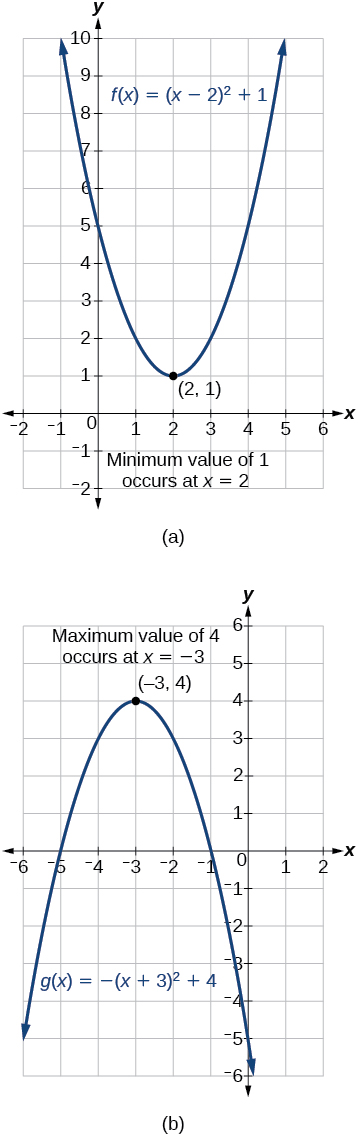
There are many real-world scenarios that involve finding the maximum or minimum value of a quadratic office, such as applications involving area and revenue.
Example \(\PageIndex{5}\): Finding the Maximum Value of a Quadratic Part
A lawn farmer wants to enclose a rectangular space for a new garden within her fenced lawn. She has purchased 80 feet of wire fencing to enclose iii sides, and she volition use a section of the backyard fence as the fourth side.
- Notice a formula for the area enclosed by the fence if the sides of fencing perpendicular to the existing fence accept length \(L\).
- What dimensions should she brand her garden to maximize the enclosed surface area?
Solution
Let'due south use a diagram such equally Figure \(\PageIndex{x}\) to tape the given data. It is also helpful to innovate a temporary variable, \(West\), to stand for the width of the garden and the length of the fence section parallel to the backyard fence.
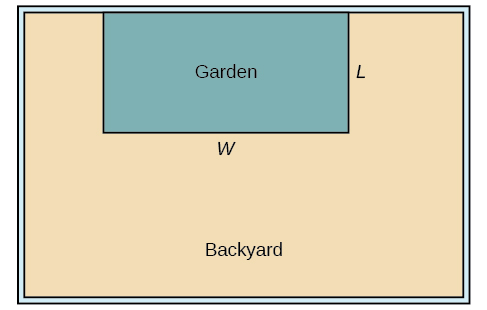
a. Nosotros know we accept just fourscore feet of fence available, and \(50+W+L=eighty\), or more only, \(2L+W=80\). This allows us to stand for the width, \(W\), in terms of \(L\).
\[W=eighty−2L\]
Now we are ready to write an equation for the area the fence encloses. We know the surface area of a rectangle is length multiplied past width, then
\[\begin{align} A&=LW=50(80−2L) \\ A(50)&=80L−2L^ii \end{marshal}\]
This formula represents the expanse of the debate in terms of the variable length \(L\). The function, written in full general course, is
\[A(Fifty)=−2L^2+80L\].
The quadratic has a negative leading coefficient, so the graph will open down, and the vertex will be the maximum value for the area. In finding the vertex, we must be careful considering the equation is not written in standard polynomial form with decreasing powers. This is why we rewrote the function in general form above. Since \(a\) is the coefficient of the squared term, \(a=−2\), \(b=80\), and \(c=0\).
To find the vertex:
\[\begin{align} h& =−\dfrac{lxxx}{ii(−2)} &chiliad&=A(20) \\ &=twenty & \text{and} \;\;\;\; &=80(20)−two(20)^2 \\ &&&=800 \end{marshal}\]
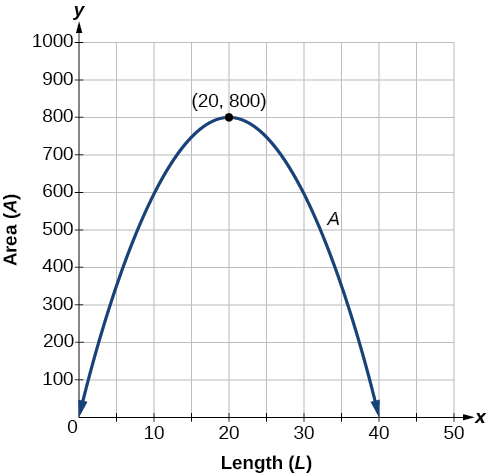
The maximum value of the function is an expanse of 800 square feet, which occurs when \(Fifty=20\) feet. When the shorter sides are 20 feet, there is 40 anxiety of fencing left for the longer side. To maximize the area, she should enclose the garden so the two shorter sides accept length xx anxiety and the longer side parallel to the existing contend has length forty feet.
Analysis
This trouble likewise could be solved by graphing the quadratic function. We can encounter where the maximum area occurs on a graph of the quadratic function in Figure \(\PageIndex{11}\).
Given an application involving acquirement, use a quadratic equation to observe the maximum.
- Write a quadratic equation for revenue.
- Find the vertex of the quadratic equation.
- Make up one's mind the y-value of the vertex.
Example \(\PageIndex{6}\): Finding Maximum Acquirement
The unit price of an detail affects its supply and demand. That is, if the unit price goes up, the demand for the item will usually decrease. For example, a local newspaper currently has 84,000 subscribers at a quarterly charge of $30. Market research has suggested that if the owners heighten the price to $32, they would lose 5,000 subscribers. Bold that subscriptions are linearly related to the price, what toll should the newspaper charge for a quarterly subscription to maximize their revenue?
Solution
Revenue is the amount of coin a company brings in. In this case, the acquirement tin can be found by multiplying the toll per subscription times the number of subscribers, or quantity. We tin introduce variables, \(p\) for toll per subscription and \(Q\) for quantity, giving us the equation \(\text{Revenue}=pQ\).
Considering the number of subscribers changes with the cost, nosotros need to find a relationship between the variables. We know that currently \(p=30\) and \(Q=84,000\). We also know that if the toll rises to $32, the paper would lose 5,000 subscribers, giving a second pair of values, \(p=32\) and \(Q=79,000\). From this we can notice a linear equation relating the 2 quantities. The slope will be
\[\begin{align} m&=\dfrac{79,000−84,000}{32−30} \\ &=−\dfrac{five,000}{2} \\ &=−2,500 \terminate{marshal}\]
This tells us the paper will lose 2,500 subscribers for each dollar they raise the price. We tin can then solve for the y-intercept.
\[\begin{align} Q&=−2500p+b &\text{Substitute in the bespeak $Q=84,000$ and $p=30$} \\ 84,000&=−2500(30)+b &\text{Solve for $b$} \\ b&=159,000 \end{align}\]
This gives usa the linear equation \(Q=−2,500p+159,000\) relating price and subscribers. We now return to our revenue equation.
\[\begin{align} \text{Revenue}&=pQ \\ \text{Revenue}&=p(−two,500p+159,000) \\ \text{Revenue}&=−2,500p^ii+159,000p \end{marshal}\]
We now have a quadratic function for revenue every bit a function of the subscription charge. To detect the price that volition maximize acquirement for the newspaper, we tin find the vertex.
\[\begin{align} h&=−\dfrac{159,000}{2(−2,500)} \\ &=31.8 \end{marshal}\]
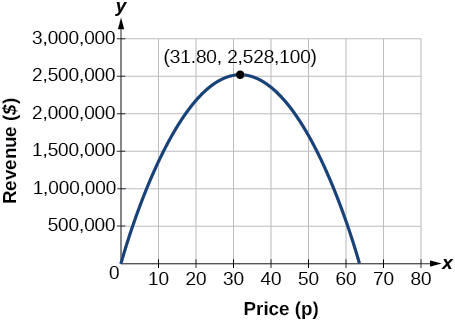
The model tells u.s. that the maximum revenue will occur if the newspaper charges $31.lxxx for a subscription. To find what the maximum revenue is, we evaluate the revenue part.
\[\brainstorm{align} \text{maximum revenue}&=−2,500(31.8)^two+159,000(31.8) \\ &=2,528,100 \end{align}\]
Analysis
This could besides be solved by graphing the quadratic as in Figure \(\PageIndex{12}\). Nosotros can see the maximum revenue on a graph of the quadratic function.
Finding the x- and y-Intercepts of a Quadratic Function
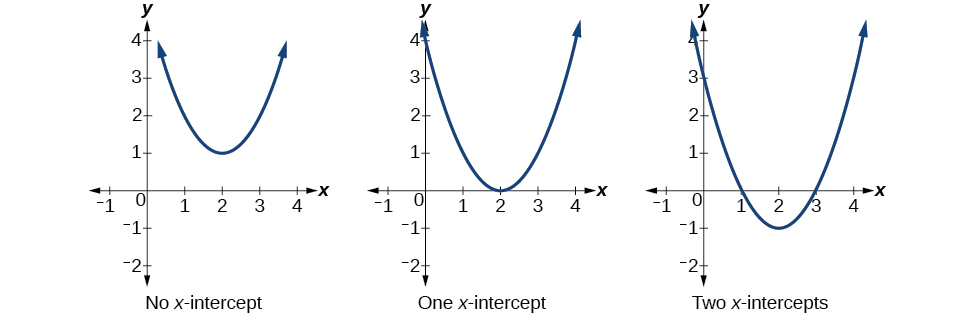
Much as we did in the application problems to a higher place, we too need to notice intercepts of quadratic equations for graphing parabolas. Recall that we find the y-intercept of a quadratic by evaluating the function at an input of zippo, and we detect the ten-intercepts at locations where the output is nix. Notice in Figure \(\PageIndex{13}\) that the number of 10-intercepts can vary depending upon the location of the graph.
Given a quadratic function \(f(x)\), find the y- and ten-intercepts.
- Evaluate \(f(0)\) to discover the y-intercept.
- Solve the quadratic equation \(f(x)=0\) to find the x-intercepts.
Instance \(\PageIndex{7}\): Finding the y- and ten-Intercepts of a Parabola
Find the y- and x-intercepts of the quadratic \(f(x)=3x^2+5x−2\).
Solution
We find the y-intercept past evaluating \(f(0)\).
\[\begin{align} f(0)&=3(0)^2+5(0)−2 \\ &=−2 \terminate{align}\]
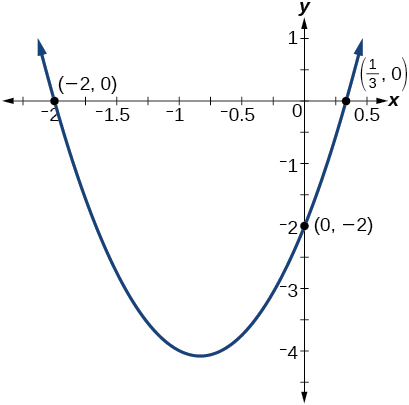
So the y-intercept is at \((0,−ii)\).
For the x-intercepts, nosotros notice all solutions of \(f(10)=0\).
\[0=3x^2+5x−2\]
In this case, the quadratic can exist factored easily, providing the simplest method for solution.
\[0=(3x−1)(10+2)\]
\[\begin{align} 0&=3x−1 & 0&=x+2 \\ x&= \frac{one}{3} &\text{or} \;\;\;\;\;\;\;\; x&=−2 \end{align}\]
So the 10-intercepts are at \((\frac{1}{3},0)\) and \((−two,0)\).
Analysis
By graphing the function, nosotros can ostend that the graph crosses the \(y\)-axis at \((0,−two)\). We can also confirm that the graph crosses the x-axis at \(\Big(\frac{i}{3},0\Big)\) and \((−2,0)\). See Figure \(\PageIndex{14}\).
Rewriting Quadratics in Standard Form
In Example \(\PageIndex{7}\), the quadratic was easily solved by factoring. Withal, at that place are many quadratics that cannot be factored. We can solve these quadratics by offset rewriting them in standard form.
Given a quadratic function, find the x-intercepts by rewriting in standard form.
- Substitute a and \(b\) into \(h=−\frac{b}{2a}\).
- Substitute \(x=h\) into the general grade of the quadratic function to discover \(k\).
- Rewrite the quadratic in standard class using \(h\) and \(k\).
- Solve for when the output of the function will be zero to discover the x-intercepts.
Instance \(\PageIndex{8}\): Finding the x-Intercepts of a Parabola
Find the x-intercepts of the quadratic function \(f(x)=2x^2+4x−four\).
Solution
We begin by solving for when the output will exist zero.
\[0=2x^ii+4x−4 \nonumber\]
Because the quadratic is not hands factorable in this case, we solve for the intercepts by first rewriting the quadratic in standard form.
\[f(x)=a(x−h)^2+k\nonumber\]
We know that \(a=2\). Then we solve for \(h\) and \(grand\).
\[\begin{align*} h&=−\dfrac{b}{2a} & yard&=f(−1) \\ &=−\dfrac{4}{two(2)} & &=ii(−i)^2+4(−ane)−4 \\ &=−ane & &=−6 \finish{marshal*}\]
And so now we can rewrite in standard course.
\[f(10)=two(x+i)^ii−6\nonumber\]
Nosotros tin can at present solve for when the output will be zero.
\[\begin{align*} 0&=ii(ten+1)^ii−6 \\ 6&=2(x+1)^ii \\ 3&=(10+1)^two \\ x+1&={\pm}\sqrt{three} \\ x&=−i{\pm}\sqrt{3} \end{marshal*}\]
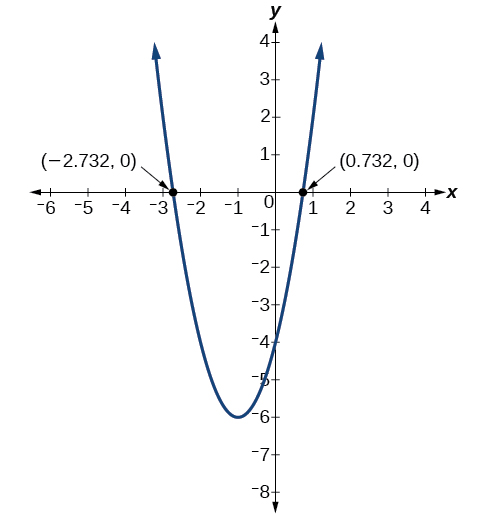
The graph has x-intercepts at \((−i−\sqrt{3},0)\) and \((−1+\sqrt{3},0)\).
Analysis
We can bank check our work by graphing the given function on a graphing utility and observing the 10-intercepts. See Figure \(\PageIndex{15}\).
Practise \(\PageIndex{i}\)
In Try It \(\PageIndex{1}\), we constitute the standard and full general form for the function \(chiliad(x)=thirteen+10^ii−6x\). At present observe the y- and x-intercepts (if whatsoever).
- Answer
-
y-intercept at \((0, xiii)\), No x-intercepts
Example \(\PageIndex{nine}\): Solving a Quadratic Equation with the Quadratic Formula
Solve \(10^2+10+2=0\).
Solution
Let'due south begin by writing the quadratic formula: \(10=\frac{−b{\pm}\sqrt{b^2−4ac}}{2a}\).
When applying the quadratic formula, we identify the coefficients \(a\), \(b\) and \(c\). For the equation \(x^2+x+ii=0\), nosotros have \(a=ane\), \(b=i\), and \(c=ii\). Substituting these values into the formula we have:
\[\brainstorm{align*} x&=\dfrac{−b{\pm}\sqrt{b^2−4ac}}{2a} \\ &=\dfrac{−i{\pm}\sqrt{one^2−4⋅1⋅(2)}}{2⋅1} \\ &=\dfrac{−one{\pm}\sqrt{i−8}}{2} \\ &=\dfrac{−1{\pm}\sqrt{−vii}}{2} \\ &=\dfrac{−1{\pm}i\sqrt{7}}{2} \end{align*}\]
The solutions to the equation are \(10=\frac{−1+i\sqrt{seven}}{2}\) and \(x=\frac{−ane-i\sqrt{7}}{ii}\) or \(ten=−\frac{1}{two}+\frac{i\sqrt{7}}{2}\) and \(x=\frac{-i}{two}−\frac{i\sqrt{7}}{ii}\).
Example \(\PageIndex{10}\): Applying the Vertex and x-Intercepts of a Parabola
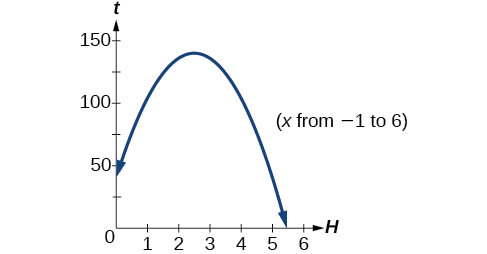
A ball is thrown upwards from the top of a 40 pes loftier building at a speed of 80 anxiety per second. The ball's height to a higher place footing can be modeled by the equation \(H(t)=−16t^two+80t+40\).
When does the brawl reach the maximum height?
What is the maximum acme of the ball?
When does the ball striking the ground?
The ball reaches the maximum top at the vertex of the parabola.
\[\brainstorm{align} h &= −\dfrac{lxxx}{ii(−16)} \\ &=\dfrac{80}{32} \\ &=\dfrac{five}{2} \\ & =2.v \end{marshal}\]
The ball reaches a maximum pinnacle afterward ii.5 seconds.
To find the maximum height, find the y-coordinate of the vertex of the parabola.
\[\begin{align} yard &=H(−\dfrac{b}{2a}) \\ &=H(2.5) \\ &=−16(2.5)^two+lxxx(2.5)+40 \\ &=140 \cease{align}\]
The ball reaches a maximum superlative of 140 anxiety.
To find when the ball hits the basis, we need to determine when the height is zero, \(H(t)=0\).
We apply the quadratic formula.
\[\begin{align} t & =\dfrac{−80±\sqrt{80^2−four(−sixteen)(40)}}{2(−16)} \\ & = \dfrac{−80±\sqrt{8960}}{−32} \stop{align} \]
Because the foursquare root does not simplify nicely, we can use a computer to approximate the values of the solutions.
\[t=\dfrac{−fourscore-\sqrt{8960}}{−32} ≈5.458 \text{ or }t=\dfrac{−80+\sqrt{8960}}{−32} ≈−0.458 \]
The second answer is outside the reasonable domain of our model, and then nosotros conclude the ball will hit the footing after about 5.458 seconds. Encounter Figure \(\PageIndex{sixteen}\).
 \(\PageIndex{5}\): A rock is thrown upward from the elevation of a 112-foot high cliff overlooking the ocean at a speed of 96 feet per second. The rock'southward peak in a higher place ocean tin can be modeled by the equation \(H(t)=−16t^2+96t+112\).
- When does the stone reach the maximum height?
- What is the maximum height of the rock?
- When does the rock hit the ocean?
Solution
a. 3 seconds b. 256 anxiety c. seven seconds
Primal Equations
- full general form of a quadratic role: \(f(ten)=ax^ii+bx+c\)
- the quadratic formula: \(x=\dfrac{−b{\pm}\sqrt{b^2−4ac}}{2a}\)
- standard form of a quadratic office: \(f(x)=a(x−h)^two+m\)
Primal Concepts
- A polynomial function of caste two is called a quadratic function.
- The graph of a quadratic office is a parabola. A parabola is a U-shaped curve that tin open either upward or down.
- The axis of symmetry is the vertical line passing through the vertex. The zeros, or x-intercepts, are the points at which the parabola crosses the ten-axis. The y-intercept is the point at which the parabola crosses the \(y\)-axis.
- Quadratic functions are ofttimes written in general class. Standard or vertex form is useful to easily identify the vertex of a parabola. Either form can exist written from a graph.
- The vertex tin be constitute from an equation representing a quadratic function. .
- The domain of a quadratic role is all real numbers. The range varies with the function.
- A quadratic function's minimum or maximum value is given by the y-value of the vertex.
- The minimum or maximum value of a quadratic function can exist used to determine the range of the function and to solve many kinds of real-world problems, including problems involving area and revenue.
- Some quadratic equations must exist solved by using the quadratic formula.
- The vertex and the intercepts tin can be identified and interpreted to solve real-world issues.
Glossary
axis of symmetry
a vertical line fatigued through the vertex of a parabola effectually which the parabola is symmetric; it is defined by \(x=−\frac{b}{2a}\).
general form of a quadratic part
the function that describes a parabola, written in the grade \(f(10)=ax^ii+bx+c\), where \(a,b,\) and \(c\) are real numbers and a≠0.
standard form of a quadratic role
the function that describes a parabola, written in the form \(f(x)=a(x−h)^ii+m\), where \((h, thou)\) is the vertex.
vertex
the betoken at which a parabola changes direction, corresponding to the minimum or maximum value of the quadratic function
vertex form of a quadratic function
another name for the standard form of a quadratic role
zeros
in a given function, the values of \(x\) at which \(y=0\), besides called roots

Express F In Standard Form,
Source: https://math.libretexts.org/Bookshelves/Algebra/Map%3A_College_Algebra_(OpenStax)/05%3A_Polynomial_and_Rational_Functions/502%3A_Quadratic_Functions
Posted by: guerreromepheculd.blogspot.com
0 Response to "Express F In Standard Form"
Post a Comment