

Differentiate Between Response And Adaptation

Mixed phytoplankton community
Phytoplankton () are the autotrophic (self-feeding) components of the plankton customs and a key function of ocean and freshwater ecosystems. The name comes from the Greek words φυτόν ( phyton ), meaning 'plant', and πλαγκτός ( planktos ), meaning 'wanderer' or 'out-of-stater'.[1] [2] [3]
Phytoplankton obtain their energy through photosynthesis, every bit exercise trees and other plants on country. This means phytoplankton must have light from the sun, so they live in the well-lit surface layers (euphotic zone) of oceans and lakes. In comparison with terrestrial plants, phytoplankton are distributed over a larger surface surface area, are exposed to less seasonal variation and accept markedly faster turnover rates than copse (days versus decades). Equally a result, phytoplankton respond rapidly on a global calibration to climate variations.
Phytoplankton grade the base of operations of marine and freshwater food webs and are key players in the global carbon wheel. They account for nearly half of global photosynthetic activity and at least half of the oxygen production, despite amounting to only about 1% of the global constitute biomass. Phytoplankton are very various, varying from photosynthesising bacteria to constitute-like algae to armour-plated coccolithophores. Important groups of phytoplankton include the diatoms, cyanobacteria and dinoflagellates, although many other groups are represented.[2]
Most phytoplankton are too small to exist individually seen with the unaided eye. However, when present in high enough numbers, some varieties may be noticeable as colored patches on the water surface due to the presence of chlorophyll within their cells and accessory pigments (such equally phycobiliproteins or xanthophylls) in some species.
Types [edit]
Phytoplankton are photosynthesizing microscopic protists and bacteria that inhabit the upper sunlit layer of almost all oceans and bodies of fresh h2o on Earth. In parallel to plants on country, phytoplankton are agents for master production in h2o.[ii] They create organic compounds from carbon dioxide dissolved in the h2o, a procedure that sustains the aquatic food spider web.[four] Phytoplankton grade the base of the marine food spider web and are crucial players in the World's carbon cycle.[5]
-

The dinoflagellate Dinophysis acuta
one µm = one micrometre
= i thousandth of a millimetre
"Marine photosynthesis is dominated by microalgae, which together with cyanobacteria, are collectively called phytoplankton."[6] Phytoplankton are extremely various, varying from photosynthesising leaner (cyanobacteria), to plant-like diatoms, to armour-plated coccolithophores.[7] [2]


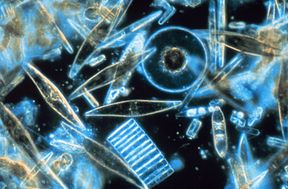
Diatoms are 1 of the most mutual types
of phytoplankton
Environmental [edit]
Global distribution of body of water phytoplankton – NASA
This visualization shows dominant phytoplankton types averaged over the menstruum 1994–1998. * Red = diatoms (big phytoplankton, which need silica) * Xanthous = flagellates (other large phytoplankton) * Green = prochlorococcus (small phytoplankton that cannot utilize nitrate) * Cyan = synechococcus (other pocket-size phytoplankton) Opacity indicates concentration of the carbon biomass. In particular, the part of the swirls and filaments (mesoscale features) appear important in maintaining high biodiversity in the ocean.[five] [viii]
Phytoplankton obtain free energy through the process of photosynthesis and must therefore alive in the well-lit surface layer (termed the euphotic zone) of an ocean, sea, lake, or other torso of water. Phytoplankton account for about one-half of all photosynthetic activity on World.[9] [10] [11] Their cumulative energy fixation in carbon compounds (main production) is the basis for the vast majority of oceanic and also many freshwater food webs (chemosynthesis is a notable exception).
While almost all phytoplankton species are obligate photoautotrophs, there are some that are mixotrophic and other, non-pigmented species that are actually heterotrophic (the latter are frequently viewed as zooplankton).[2] [12] Of these, the all-time known are dinoflagellate genera such every bit Noctiluca and Dinophysis, that obtain organic carbon by ingesting other organisms or detrital material.

Cycling of marine phytoplankton[thirteen]
Phytoplankton live in the photic zone of the ocean, where photosynthesis is possible. During photosynthesis, they digest carbon dioxide and release oxygen. If solar radiation is too loftier, phytoplankton may fall victim to photodegradation. Phytoplankton species feature a large variety of photosynthetic pigments which species-specifically enables them to absorb different wavelengths of the variable underwater light.[14] This implies unlike species tin can utilise the wavelength of calorie-free different efficiently and the light is not a single ecological resource but a multitude of resources depending on its spectral limerick.[xv] By that it was institute that changes in the spectrum of light solitary can alter natural phytoplankton communities even if the same intensity is available.[16] For growth, phytoplankton cells additionally depend on nutrients, which enter the sea by rivers, continental weathering, and glacial ice meltwater on the poles. Phytoplankton release dissolved organic carbon (Medico) into the ocean. Since phytoplankton are the basis of marine food webs, they serve as casualty for zooplankton, fish larvae and other heterotrophic organisms. They can as well exist degraded by bacteria or by viral lysis. Although some phytoplankton cells, such equally dinoflagellates, are able to migrate vertically, they are still incapable of actively moving against currents, so they slowly sink and ultimately fertilize the seafloor with dead cells and detritus.[13]
Phytoplankton are crucially dependent on minerals. These are primarily macronutrients such as nitrate, phosphate or silicic acrid, whose availability is governed by the balance between the so-called biological pump and upwelling of deep, nutrient-rich waters. Phytoplankton nutrient composition drives and is driven by the Redfield ratio of macronutrients generally available throughout the surface oceans. However, across large areas of the oceans such as the Antarctic ocean, phytoplankton are limited by the lack of the micronutrient iron. This has led to some scientists advocating iron fertilization as a means to annul the accumulation of human-produced carbon dioxide (CO2) in the temper.[17] Large-scale experiments accept added fe (usually as salts such as iron sulphate) to the oceans to promote phytoplankton growth and depict atmospheric CO2 into the body of water. Controversy about manipulating the ecosystem and the efficiency of iron fertilization has slowed such experiments.[18]
Phytoplankton depend on B Vitamins for survival. Areas in the ocean have been identified every bit having a major lack of some B Vitamins, and correspondingly, phytoplankton.[19]
The effects of anthropogenic warming on the global population of phytoplankton is an area of active research. Changes in the vertical stratification of the water column, the rate of temperature-dependent biological reactions, and the atmospheric supply of nutrients are expected to have important effects on future phytoplankton productivity.[twenty] [21]
The effects of anthropogenic ocean acidification on phytoplankton growth and community structure has also received considerable attention. Phytoplankton such as coccolithophores contain calcium carbonate cell walls that are sensitive to ocean acidification. Because of their short generation times, prove suggests some phytoplankton tin can adapt to changes in pH induced by increased carbon dioxide on rapid time-scales (months to years).[22] [23]
Phytoplankton serve as the base of the aquatic food web, providing an essential ecological function for all aquatic life. Nether future weather of anthropogenic warming and body of water acidification, changes in phytoplankton bloodshed due to changes in rates of zooplankton grazing may be significant.[24] One of the many nutrient chains in the ocean – remarkable due to the small number of links – is that of phytoplankton sustaining krill (a crustacean like to a tiny shrimp), which in turn sustain baleen whales.
The El Niño-Southern Oscillation(ENSO) cycles in the Equatorial Pacific expanse can affect phytoplankton.[25] Biochemical and physical changes during ENSO cycles modify the phytoplankton community structure.[25] Also, changes in the construction of the phytoplankton, such as a significant reduction in biomass and phytoplankton density, particularly during El Nino phases can occur.[26] Existence phytoplankton sensitive to environmental changes is why it is used as an indicator of estuarine and coastal ecological weather condition and health.[27] To written report these events satellite ocean color observations are used to detect these changes. Satellite images help to take a better view of their global distribution.[25]
Diversity [edit]

When two currents collide (here the Oyashio and Kuroshio currents) they create eddies. Phytoplankton concentrates forth the boundaries of the eddies, tracing the movement of the water.
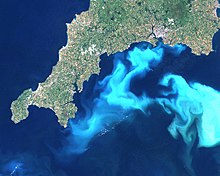

NASA satellite view of Southern ocean phytoplankton bloom
The term phytoplankton encompasses all photoautotrophic microorganisms in aquatic nutrient webs. However, different terrestrial communities, where virtually autotrophs are plants, phytoplankton are a diverse group, incorporating protistan eukaryotes and both eubacterial and archaebacterial prokaryotes. There are well-nigh 5,000 known species of marine phytoplankton.[28] How such diversity evolved despite deficient resource (restricting niche differentiation) is unclear.[29]
In terms of numbers, the most important groups of phytoplankton include the diatoms, blue-green alga and dinoflagellates, although many other groups of algae are represented. One grouping, the coccolithophorids, is responsible (in office) for the release of significant amounts of dimethyl sulfide (DMS) into the atmosphere. DMS is oxidized to form sulfate which, in areas where ambient aerosol particle concentrations are depression, can contribute to the population of cloud condensation nuclei, mostly leading to increased deject cover and cloud albedo according to the so-called Hook Hypothesis.[thirty] [31] Different types of phytoplankton back up different trophic levels inside varying ecosystems. In oligotrophic oceanic regions such every bit the Sargasso Sea or the Due south Pacific Gyre, phytoplankton is dominated by the small-scale sized cells, called picoplankton and nanoplankton (too referred to equally picoflagellates and nanoflagellates), generally equanimous of cyanobacteria (Prochlorococcus, Synechococcus) and picoeucaryotes such equally Micromonas. Within more than productive ecosystems, dominated past upwelling or high terrestrial inputs, larger dinoflagellates are the more ascendant phytoplankton and reflect a larger portion of the biomass.[32]
Growth strategies [edit]
In the early twentieth century, Alfred C. Redfield found the similarity of the phytoplankton'due south elemental composition to the major dissolved nutrients in the deep ocean.[33] Redfield proposed that the ratio of carbon to nitrogen to phosphorus (106:16:1) in the ocean was controlled by the phytoplankton'due south requirements, equally phytoplankton subsequently release nitrogen and phosphorus every bit they are remineralized. This and then-called "Redfield ratio" in describing stoichiometry of phytoplankton and seawater has become a primal principle to sympathize marine environmental, biogeochemistry and phytoplankton evolution.[34] Still, the Redfield ratio is not a universal value and it may diverge due to the changes in exogenous nutrient delivery[35] and microbial metabolisms in the ocean, such as nitrogen fixation, denitrification and anammox.
The dynamic stoichiometry shown in unicellular algae reflects their capability to store nutrients in an internal puddle, shift between enzymes with various nutrient requirements and alter osmolyte limerick.[36] [37] Dissimilar cellular components have their own unique stoichiometry characteristics,[34] for instance, resource (calorie-free or nutrients) acquisition machinery such equally proteins and chlorophyll contain a loftier concentration of nitrogen but low in phosphorus. Meanwhile, growth machinery such as ribosomal RNA contains high nitrogen and phosphorus concentrations.
Based on allocation of resources, phytoplankton is classified into three unlike growth strategies, namely survivalist, bloomer[38] and generalist. Survivalist phytoplankton has a high ratio of N:P (>30) and contains an abundance of resource-acquisition machinery to sustain growth nether deficient resources. Bloomer phytoplankton has a low N:P ratio (<10), contains a high proportion of growth machinery, and is adapted to exponential growth. Generalist phytoplankton has like Due north:P to the Redfield ratio and contain relatively equal resources-conquering and growth machinery.
Factors affecting abundance [edit]
The NAAMES study was a v-twelvemonth scientific research program conducted between 2015 and 2019 by scientists from Oregon Country University and NASA to investigated aspects of phytoplankton dynamics in ocean ecosystems, and how such dynamics influence atmospheric aerosols, clouds, and climate (NAAMES stands for the North Atlantic Aerosols and Marine Ecosystems Written report). The written report focused on the sub-arctic region of the North Atlantic Ocean, which is the site of one of World's largest recurring phytoplankton blooms. The long history of enquiry in this location, as well as relative ease of accessibility, made the North Atlantic an ideal location to test prevailing scientific hypotheses[39] in an endeavor to meliorate understand the role of phytoplankton aerosol emissions on Globe's free energy budget.[twoscore]
NAAMES was designed to target specific phases of the annual phytoplankton wheel: minimum, climax and the intermediary decreasing and increasing biomass, in society to resolve debates on the timing of bloom formations and the patterns driving annual bloom re-creation.[twoscore] The NAAMES project also investigated the quantity, size, and composition of aerosols generated by principal product in society to understand how phytoplankton flower cycles affect cloud formations and climate.[41]
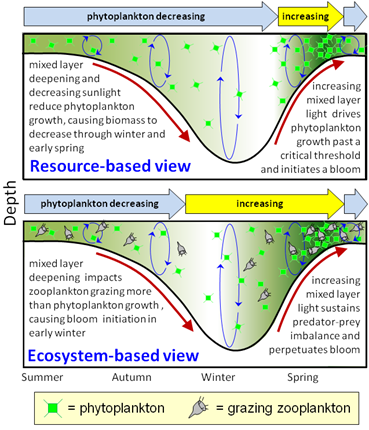
Competing hypothesis of plankton variability[39]
Figure adapted from Behrenfeld & Boss 2014.[42]
Courtesy of NAAMES, Langley Research Center, NASA[43]

World concentrations of surface bounding main chlorophyll as viewed past satellite during the northern spring, averaged from 1998 to 2004. Chlorophyll is a marker for the distribution and affluence of phytoplankton.

This map past NOAA shows coastal areas where upwelling occurs. Nutrients that accompany upwelling can heighten phytoplankton affluence

Relationships betwixt phytoplankton species richness and temperature or latitude
(A) The natural logarithm of the annual mean of monthly phytoplankton richness is shown every bit a function of body of water temperature (m, Boltzmann'south constant; T, temperature in kelvin). Filled and open circles signal areas where the model results cover 12 or less than 12 months, respectively. Trend lines are shown separately for each hemisphere (regressions with local polynomial fitting). The solid black line represents the linear fit to richness, and the dashed black line indicates the slope expected from metabolic theory (−0.32). The map inset visualizes richness deviations from the linear fit. The relative area of 3 different thermal regimes (separated by sparse vertical lines) is given at the bottom of the figure. Observed thermal (B) and latitudinal (C) ranges of individual species are displayed by greyness horizontal confined (minimum to maximum, dots for median) and ordered from wide-ranging (bottom) to narrow-ranging (top). The 10 centrality in (C) is reversed for comparison with (B). Red lines show the expected richness based on the overlapping ranges, and bluish lines depict the species' average range size (±1 SD, blue shading) at any item x value. Lines are shown for areas with higher confidence.[44]

Global patterns of monthly phytoplankton species richness and species turnover
(A) Almanac hateful of monthly species richness and (B) calendar month-to-month species turnover projected by SDMs. Latitudinal gradients of (C) richness and (D) turnover. Colored lines (regressions with local polynomial plumbing fixtures) point the means per degree latitude from three different SDM algorithms used (red shading denotes ±ane SD from m Monte Carlo runs that used varying predictors for GAM). Poleward of the thin horizontal lines shown in (C) and (D), the model results cover merely <12 or <9 months, respectively.[44]
Factors affecting productivity [edit]

Environmental factors that touch phytoplankton productivity[45] [46]
Phytoplankton are the primal mediators of the biological pump. Understanding the response of phytoplankton to changing environmental conditions is a prerequisite to predict future atmospheric concentrations of CO2. Temperature, irradiance and nutrient concentrations, along with COii are the chief environmental factors that influence the physiology and stoichiometry of phytoplankton.[47] The stoichiometry or elemental composition of phytoplankton is of utmost importance to secondary producers such as copepods, fish and shrimp, because it determines the nutritional quality and influences energy flow through the marine food bondage.[48] Climate change may greatly restructure phytoplankton communities leading to cascading consequences for marine food webs, thereby altering the corporeality of carbon transported to the sea interior.[49] [45]
The diagram on the correct gives an overview of the various ecology factors that together bear upon phytoplankton productivity. All of these factors are expected to undergo significant changes in the hereafter bounding main due to global alter.[fifty] Global warming simulations predict oceanic temperature increase; dramatic changes in oceanic stratification, circulation and changes in cloud cover and sea ice, resulting in an increased light supply to the body of water surface. Also, reduced nutrient supply is predicted to co-occur with bounding main acidification and warming, due to increased stratification of the h2o cavalcade and reduced mixing of nutrients from the deep water to the surface.[51] [45]
Role of phytoplankton [edit]

Role of phytoplankton on various compartments of the marine environment[52]
In the diagram on the right, the compartments influenced past phytoplankton include the atmospheric gas composition, inorganic nutrients, and trace chemical element fluxes as well as the transfer and cycling of organic matter via biological processes. The photosynthetically stock-still carbon is apace recycled and reused in the surface bounding main, while a sure fraction of this biomass is exported as sinking particles to the deep sea, where it is subject area to ongoing transformation processes, e.g., remineralization.[52]
Anthropogenic changes [edit]

Oxygen-phyto-zooplankton dynamics
is afflicted by racket from different origins[53]
As for any other species or ecological customs, the oxygen-plankton system is afflicted by environmental noise of various origins, such as the inherent stochasticity (randomness) of weather conditions.
Marine phytoplankton perform half of the global photosynthetic CO2 fixation (internet global chief product of ~fifty Pg C per year) and one-half of the oxygen production despite amounting to merely ~1% of global constitute biomass.[54] In comparison with terrestrial plants, marine phytoplankton are distributed over a larger surface area, are exposed to less seasonal variation and accept markedly faster turnover rates than trees (days versus decades).[54] Therefore, phytoplankton respond rapidly on a global calibration to climate variations. These characteristics are important when i is evaluating the contributions of phytoplankton to carbon fixation and forecasting how this production may modify in response to perturbations. Predicting the effects of climate alter on primary productivity is complicated by phytoplankton blossom cycles that are affected by both lesser-up control (for example, availability of essential nutrients and vertical mixing) and peak-down control (for case, grazing and viruses).[55] [54] [56] [57] [58] [59] Increases in solar radiation, temperature and freshwater inputs to surface waters strengthen ocean stratification and consequently reduce ship of nutrients from deep h2o to surface waters, which reduces primary productivity.[54] [59] [60] Conversely, rise CO2 levels can increase phytoplankton master production, but only when nutrients are not limiting.[61] [62] [63] [24]

Plot demonstrating increases in phytoplankton species richness with increased temperature
Some studies indicate that overall global oceanic phytoplankton density has decreased in the by century,[64] simply these conclusions accept been questioned because of the limited availability of long-term phytoplankton data, methodological differences in information generation and the large almanac and decadal variability in phytoplankton production.[65] [66] [67] [68] Moreover, other studies suggest a global increment in oceanic phytoplankton production[69] and changes in specific regions or specific phytoplankton groups.[70] [71] The global Sea Ice Index is failing,[72] leading to higher light penetration and potentially more main production;[73] however, there are alien predictions for the effects of variable mixing patterns and changes in nutrient supply and for productivity trends in polar zones.[59] [24]
The effect of man-caused climate change on phytoplankton biodiversity is not well understood. Should greenhouse gas emissions continue rising to high levels by 2100, some phytoplankton models predict an increase in species richness, or the number of dissimilar species within a given area. This increment in plankton diversity is traced to warming ocean temperatures. In add-on to species richness changes, the locations where phytoplankton are distributed are expected to shift towards the Earth'due south poles. Such movement may disrupt ecosystems, because phytoplankton are consumed by zooplankton, which in turn sustain fisheries. This shift in phytoplankton location may as well diminish the ability of phytoplankton to store carbon that was emitted past homo activities. Man (anthropogenic) changes to phytoplankton impact both natural and economic processes.[74]
Aquaculture [edit]
Phytoplankton are a fundamental food particular in both aquaculture and mariculture. Both apply phytoplankton as food for the animals being farmed. In mariculture, the phytoplankton is naturally occurring and is introduced into enclosures with the normal apportionment of seawater. In aquaculture, phytoplankton must exist obtained and introduced direct. The plankton can either be nerveless from a body of water or cultured, though the old method is seldom used. Phytoplankton is used as a foodstock for the product of rotifers,[75] which are in turn used to feed other organisms. Phytoplankton is also used to feed many varieties of aquacultured molluscs, including pearl oysters and giant clams. A 2018 study estimated the nutritional value of natural phytoplankton in terms of carbohydrate, poly peptide and lipid beyond the globe ocean using ocean-colour information from satellites,[76] and institute the calorific value of phytoplankton to vary considerably beyond different oceanic regions and betwixt unlike time of the year.[76] [77]
The product of phytoplankton under artificial conditions is itself a grade of aquaculture. Phytoplankton is cultured for a variety of purposes, including foodstock for other aquacultured organisms,[75] a nutritional supplement for captive invertebrates in aquaria. Culture sizes range from modest laboratory cultures of less than 1L to several tens of thousands of liters for commercial aquaculture.[75] Regardless of the size of the culture, sure conditions must exist provided for efficient growth of plankton. The majority of cultured plankton is marine, and seawater of a specific gravity of i.010 to ane.026 may be used every bit a culture medium. This h2o must be sterilized, usually by either high temperatures in an autoclave or by exposure to ultraviolet radiation, to prevent biological contamination of the culture. Various fertilizers are added to the culture medium to facilitate the growth of plankton. A culture must be aerated or agitated in some way to keep plankton suspended, as well equally to provide dissolved carbon dioxide for photosynthesis. In addition to constant aeration, virtually cultures are manually mixed or stirred on a regular basis. Lite must be provided for the growth of phytoplankton. The colour temperature of illumination should be approximately 6,500 One thousand, but values from 4,000 K to upwards of 20,000 K have been used successfully. The duration of light exposure should be approximately 16 hours daily; this is the nearly efficient bogus mean solar day length.[75]
Come across also [edit]
- Algaculture – Aquaculture involving the farming of algae
- AlgaeBase – Species database
- Bacterioplankton – Bacterial component of the plankton that drifts in the water column
- Biological pump – Carbon capture process in oceans
- Claw hypothesis – A hypothesised negative feedback loop connecting the marine biota and the climate
- Critical depth
- Deep chlorophyll maximum
- Freshwater phytoplankton – Phytoplankton occurring in freshwater ecosystems
- Fe fertilization
- Microphyte (microalgae)
- NAAMES
- Ocean acidification – Climate change-induced reject of pH levels in the bounding main
- Paradox of the plankton – The ecological observation of loftier plankton diversity despite competition for few resources
- Photosynthetic picoplankton
- Whiting consequence – Suspension of fine-grained calcium carbonate particles in h2o bodies
- Thin layers (oceanography) – Congregations of plankton
References [edit]
- ^ Thurman, H. V. (2007). Introductory Oceanography. Bookish Net Publishers. ISBN978-i-4288-3314-ii. [ page needed ]
- ^ a b c d eastward Pierella Karlusich, Juan José; Ibarbalz, Federico M.; Bowler, Chris (iii Jan 2020). "Phytoplankton in the Tara Ocean". Annual Review of Marine Science. 12 (one): 233–265. Bibcode:2020ARMS...12..233P. doi:10.1146/annurev-marine-010419-010706. ISSN 1941-1405. PMID 31899671. S2CID 209748051.
- ^ Pierella Karlusich, Juan José; Ibarbalz, Federico M; Bowler, Chris (2020). "Exploration of marine phytoplankton: from their historical appreciation to the omics era". Journal of Plankton Enquiry. 42: 595–612. doi:10.1093/plankt/fbaa049.
- ^ Ghosal; Rogers; Wray, S.; G.; A. "The Effects of Turbulence on Phytoplankton". Aerospace Engineering Enterprise. NTRS. Retrieved sixteen June 2011.
{{cite web}}: CS1 maint: multiple names: authors list (link) - ^ a b Modeled Phytoplankton Communities in the Global Body of water NASA Hyperwall, 30 September 2015.
 This commodity incorporates text from this source, which is in the public domain.
 - ^ Parker, Micaela South.; Mock, Thomas; Armbrust, E. Virginia (2008). "Genomic Insights into Marine Microalgae". Almanac Review of Genetics. 42: 619–645. doi:10.1146/annurev.genet.42.110807.091417. PMID 18983264.
- ^ Lindsey, R., Scott, K. and Simmon, R. (2010) "What are phytoplankton". NASA Earth Observatory.
- ^ Darwin Project Massachusetts Institute of Applied science.
- ^ Michael J. Behrenfeld; et al. (30 March 2001). "Biospheric principal production during an ENSO transition" (PDF). Science. 291 (5513): 2594–7. Bibcode:2001Sci...291.2594B. doi:10.1126/science.1055071. PMID 11283369. S2CID 38043167.
- ^ "NASA Satellite Detects Red Glow to Map Global Ocean Plant Health" NASA, 28 May 2009.
- ^ "Satellite Sees Ocean Plants Increment, Coasts Greening". NASA. 2 March 2005. Retrieved 9 June 2014.
- ^ Mitra, Aditee; Flynn, Kevin J.; Tillmann, Urban; Raven, John A.; Caron, David; Stoecker, Diane K.; Not, Fabrice; Hansen, Per J.; Hallegraeff, Gustaaf; Sanders, Robert; Wilken, Susanne; McManus, George; Johnson, Mathew; Pitta, Paraskevi; Våge, Selina; Berge, Terje; Calbet, Albert; Thingstad, Frede; Jeong, Hae Jin; Burkholder, Joann; Glibert, Patricia Yard.; Granéli, Edna; Lundgren, Veronica (i April 2016). "Defining Planktonic Protist Functional Groups on Mechanisms for Free energy and Nutrient Acquisition: Incorporation of Various Mixotrophic Strategies". Protist. 167 (2): 106–120. doi:10.1016/j.protis.2016.01.003. ISSN 1434-4610. PMID 26927496.
- ^ a b Käse 50, Geuer JK. (2018) "Phytoplankton responses to marine climate change–an introduction". In Jungblut South., Liebich V., Bode M. (Eds) YOUMARES viii–Oceans Across Boundaries: Learning from each other, pages 55–72, Springer. doi:ten.1007/978-3-319-93284-2_5.
 Material was copied from this source, which is available nether a Creative Eatables Attribution four.0 International License.
 - ^ Kirk, John T. O. (1994). Light and Photosynthesis in Aquatic Ecosystems (2 ed.). Cambridge: Cambridge University Printing. doi:10.1017/cbo9780511623370. ISBN9780511623370.
- ^ Stomp, Maayke; Huisman, Jef; de Jongh, Floris; Veraart, Annelies J.; Gerla, Daan; Rijkeboer, Machteld; Ibelings, Bas Due west.; Wollenzien, Ute I. A.; Stal, Lucas J. (November 2004). "Adaptive divergence in paint composition promotes phytoplankton biodiversity". Nature. 432 (7013): 104–107. Bibcode:2004Natur.432..104S. doi:10.1038/nature03044. ISSN 1476-4687. PMID 15475947. S2CID 4409758.
- ^ Hintz, Nils Hendrik; Zeising, Moritz; Striebel, Maren (2021). "Changes in spectral quality of underwater low-cal alter phytoplankton community composition". Limnology and Oceanography. 66 (9): 3327–3337. Bibcode:2021LimOc..66.3327H. doi:10.1002/lno.11882. ISSN 1939-5590. S2CID 237849374.
- ^ Richtel, M. (one May 2007). "Recruiting Plankton to Fight Global Warming". The New York Times.
- ^ Monastersky, Richard (1995). "Atomic number 26 versus the Greenhouse: Oceanographers Cautiously Explore a Global Warming Therapy". Science News. 148 (xiv): 220–one. doi:10.2307/4018225. JSTOR 4018225.
- ^ Sañudo-Wilhelmy, Sergio (23 June 2012). "Existence of vitamin 'deserts' in the ocean confirmed". ScienceDaily.
- ^ Henson, S. A.; Sarmiento, J. Fifty.; Dunne, J. P.; Bopp, L.; Lima, I.; Doney, Due south. C.; John, J.; Beaulieu, C. (2010). "Detection of anthropogenic climate alter in satellite records of ocean chlorophyll and productivity". Biogeosciences. 7 (two): 621–twoscore. Bibcode:2010BGeo....7..621H. doi:10.5194/bg-7-621-2010.
- ^ Steinacher, M.; Joos, F.; Frölicher, T. L.; Bopp, L.; Cadule, P.; Cocco, V.; Doney, S. C.; Gehlen, 1000.; Lindsay, 1000.; Moore, J. K.; Schneider, B.; Segschneider, J. (2010). "Projected 21st century decrease in marine productivity: a multi-model assay". Biogeosciences. vii (3): 979–1005. Bibcode:2010BGeo....7..979S. doi:10.5194/bg-7-979-2010.
- ^ Collins, Sinéad; Rost, Björn; Rynearson, Tatiana A. (25 Nov 2013). "Evolutionary potential of marine phytoplankton under body of water acidification". Evolutionary Applications. seven (1): 140–155. doi:10.1111/eva.12120. ISSN 1752-4571. PMC3894903. PMID 24454553.
- ^ Lohbeck, Kai T.; Riebesell, Ulf; Reusch, Thorsten B. H. (8 April 2012). "Adaptive evolution of a central phytoplankton species to sea acidification". Nature Geoscience. v (v): 346–351. Bibcode:2012NatGe...five..346L. doi:10.1038/ngeo1441. ISSN 1752-0894.
- ^ a b c Cavicchioli, Ricardo; Ripple, William J.; Timmis, Kenneth N.; Azam, Farooq; Bakken, Lars R.; Baylis, Matthew; Behrenfeld, Michael J.; Boetius, Antje; Boyd, Philip West.; Classen, Aimée T.; Crowther, Thomas W.; Danovaro, Roberto; Foreman, Christine G.; Huisman, Jef; Hutchins, David A.; Jansson, Janet Chiliad.; Karl, David M.; Koskella, Britt; Mark Welch, David B.; Martiny, Jennifer B. H.; Moran, Mary Ann; Orphan, Victoria J.; Reay, David Due south.; Remais, Justin V.; Rich, Virginia I.; Singh, Brajesh K.; Stein, Lisa Y.; Stewart, Frank J.; Sullivan, Matthew B.; et al. (2019). "Scientists' warning to humanity: Microorganisms and climate change". Nature Reviews Microbiology. 17 (nine): 569–586. doi:10.1038/s41579-019-0222-5. PMC7136171. PMID 31213707. Material was copied from this source, which is available under a Creative Eatables Attribution 4.0 International License.
- ^ a b c Masotti, I.; Moulin, C.; Alvain, S.; Bopp, 50.; Tagliabue, A.; Antoine, D. (4 March 2011). "Big-scale shifts in phytoplankton groups in the Equatorial Pacific during ENSO cycles". Biogeosciences. eight (3): 539–550. Bibcode:2011BGeo....8..539M. doi:10.5194/bg-eight-539-2011. hdl:20.500.11937/40912.
- ^ Sathicqab, María Belén; Bauerac, Delia Elena; Gómez, Nora (15 September 2015). "Influence of El Niño Southern Oscillation miracle on coastal phytoplankton in a mixohaline ecosystem on the southeastern of South America: Río de la Plata estuary". Marine Pollution Bulletin. 98 (1–2): 26–33. doi:x.1016/j.marpolbul.2015.07.017. PMID 26183307.
- ^ Sathicq, María Belén; Bauer, Delia Elena; Gómez, Nora (15 September 2015). "Influence of El Niño Southern Oscillation phenomenon on coastal phytoplankton in a mixohaline ecosystem on the southeastern of South America: Río de la Plata estuary". Marine Pollution Bulletin. 98 (1–ii): 26–33. doi:10.1016/j.marpolbul.2015.07.017. PMID 26183307.
- ^ Hallegraeff, K.Chiliad. (2003). "Harmful algal blooms: a global overview" (PDF). In Hallegraeff, Gustaaf M.; Anderson, Donald Mark; Cembella, Allan D.; Enevoldsen, Henrik O. (eds.). Manual on Harmful Marine Microalgae. Unesco. pp. 25–49. ISBN978-92-iii-103871-6.
- ^ Hutchinson, G. E. (1961). "The Paradox of the Plankton". The American Naturalist. 95 (882): 137–45. doi:ten.1086/282171. S2CID 86353285.
- ^ Charlson, Robert J.; Lovelock, James E.; Andreae, Meinrat O.; Warren, Stephen G. (1987). "Oceanic phytoplankton, atmospheric sulphur, cloud albedo and climate". Nature. 326 (6114): 655–61. Bibcode:1987Natur.326..655C. doi:ten.1038/326655a0. S2CID 4321239.
- ^ Quinn, P. K.; Bates, T. S. (2011). "The example against climate regulation via oceanic phytoplankton sulphur emissions". Nature. 480 (7375): 51–half-dozen. Bibcode:2011Natur.480...51Q. doi:10.1038/nature10580. PMID 22129724. S2CID 4417436.
- ^ Calbet, A. (2008). "The trophic roles of microzooplankton in marine systems". ICES Journal of Marine Science. 65 (iii): 325–31. doi:x.1093/icesjms/fsn013.
- ^ Redfield, Alfred C. (1934). "On the Proportions of Organic Derivatives in Ocean H2o and their Relation to the Composition of Plankton". In Johnstone, James; Daniel, Richard Jellicoe (eds.). James Johnstone Memorial Volume. Liverpool: University Press of Liverpool. pp. 176–92. OCLC 13993674.
- ^ a b Arrigo, Kevin R. (2005). "Marine microorganisms and global nutrient cycles". Nature. 437 (7057): 349–55. Bibcode:2005Natur.437..349A. doi:10.1038/nature04159. PMID 16163345. S2CID 62781480.
- ^ Fanning, Kent A. (1989). "Influence of atmospheric pollution on nutrient limitation in the body of water". Nature. 339 (6224): 460–63. Bibcode:1989Natur.339..460F. doi:10.1038/339460a0. S2CID 4247689.
- ^ Sterner, Robert Warner; Elser, James J. (2002). Ecological Stoichiometry: The Biological science of Elements from Molecules to the Biosphere. Princeton University Printing. ISBN978-0-691-07491-vii. [ page needed ]
- ^ Klausmeier, Christopher A.; Litchman, Elena; Levin, Simon A. (2004). "Phytoplankton growth and stoichiometry under multiple nutrient limitation". Limnology and Oceanography. 49 (4 Part 2): 1463–70. Bibcode:2004LimOc..49.1463K. doi:10.4319/lo.2004.49.4_part_2.1463. S2CID 16438669.
- ^ Klausmeier, Christopher A.; Litchman, Elena; Daufresne, Tanguy; Levin, Simon A. (2004). "Optimal nitrogen-to-phosphorus stoichiometry of phytoplankton". Nature. 429 (6988): 171–4. Bibcode:2004Natur.429..171K. doi:x.1038/nature02454. PMID 15141209. S2CID 4308845.
- ^ a b Behrenfeld, M.J. and Boss, E.S. (2018) "Student's tutorial on blossom hypotheses in the context of phytoplankton annual cycles". Global change biological science, 24(one): 55–77. doi:10.1111/gcb.13858.
- ^ a b Behrenfeld, Michael J.; Moore, Richard H.; Hostetler, Chris A.; Graff, Jason; Gaube, Peter; Russell, Lynn M.; Chen, Gao; Doney, Scott C.; Giovannoni, Stephen; Liu, Hongyu; Proctor, Christopher (22 March 2019). "The North Atlantic Aerosol and Marine Ecosystem Written report (NAAMES): Science Motive and Mission Overview". Frontiers in Marine Science. 6: 122. doi:x.3389/fmars.2019.00122. ISSN 2296-7745.
- ^ Engel, Anja; Bange, Hermann Due west.; Cunliffe, Michael; Burrows, Susannah M.; Friedrichs, Gernot; Galgani, Luisa; Herrmann, Hartmut; Hertkorn, Norbert; Johnson, Martin; Liss, Peter Due south.; Quinn, Patricia Thousand. (xxx May 2017). "The Body of water's Vital Pare: Toward an Integrated Agreement of the Sea Surface Microlayer". Frontiers in Marine Science. 4. doi:10.3389/fmars.2017.00165. ISSN 2296-7745.
- ^ Behrenfeld, Michael J.; Boss, Emmanuel S. (three January 2014). "Resurrecting the Ecological Underpinnings of Ocean Plankton Blooms". Almanac Review of Marine Science. 6 (ane): 167–194. Bibcode:2014ARMS....6..167B. doi:10.1146/annurev-marine-052913-021325. ISSN 1941-1405. PMID 24079309. S2CID 12903662.
- ^ NAAMES: Scientific discipline - Objectives Langley Enquiry Middle, NASA, Updated: 6 June 2020. Retrieved: 15 June 2020.
- ^ a b Righetti, D., Vogt, M., Gruber, Northward., Psomas, A. and Zimmermann, N.E. (2019) "Global pattern of phytoplankton multifariousness driven by temperature and environmental variability". Scientific discipline advances, 5(5): eaau6253. doi:10.1126/sciadv.aau6253. Material was copied from this source, which is bachelor under a Creative Commons Attribution 4.0 International License.
- ^ a b c Beardall, John; Stojkovic, Slobodanka; Larsen, Stuart (2009). "Living in a high CO2world: Impacts of global climate change on marine phytoplankton". Plant Environmental & Diversity. 2 (2): 191–205. doi:10.1080/17550870903271363. S2CID 83586220.
- ^ Basu, Samarpita; MacKey, Katherine (2018). "Phytoplankton as Key Mediators of the Biological Carbon Pump: Their Responses to a Changing Climate". Sustainability. 10 (3): 869. doi:x.3390/su10030869. Cloth was copied from this source, which is available under a Artistic Commons Attribution 4.0 International License.
- ^ Moreno, Allison R.; Hagstrom, George I.; Primeau, Francois W.; Levin, Simon A.; Martiny, Adam C. (2018). "Marine phytoplankton stoichiometry mediates nonlinear interactions between nutrient supply, temperature, and atmospheric CO2". Biogeosciences. 15 (9): 2761–2779. Bibcode:2018BGeo...15.2761M. doi:10.5194/bg-15-2761-2018.
- ^ Li, Wei; Gao, Kunshan; Beardall, John (2012). "Interactive Effects of Ocean Acidification and Nitrogen-Limitation on the Diatom Phaeodactylum tricornutum". PLOS ONE. 7 (12): e51590. Bibcode:2012PLoSO...751590L. doi:ten.1371/journal.pone.0051590. PMC3517544. PMID 23236517.
- ^ Irwin, Andrew J.; Finkel, Zoe V.; Müller-Karger, Frank E.; Troccoli Ghinaglia, Luis (2015). "Phytoplankton accommodate to irresolute body of water environments". Proceedings of the National University of Sciences. 112 (18): 5762–5766. Bibcode:2015PNAS..112.5762I. doi:10.1073/pnas.1414752112. PMC4426419. PMID 25902497.
- ^ Häder, Donat-P.; Villafañe, Virginia E.; Helbling, E. Walter (2014). "Productivity of aquatic chief producers under global climate change". Photochem. Photobiol. Sci. xiii (10): 1370–1392. doi:10.1039/C3PP50418B. PMID 25191675.
- ^ Sarmiento, J. L.; Slater, R.; Hairdresser, R.; Bopp, L.; Doney, Due south. C.; Hirst, A. C.; Kleypas, J.; Matear, R.; Mikolajewicz, U.; Monfray, P.; Soldatov, V.; Spall, S. A.; Stouffer, R. (2004). "Response of ocean ecosystems to climate warming". Global Biogeochemical Cycles. 18 (3): n/a. Bibcode:2004GBioC..18.3003S. doi:10.1029/2003GB002134.
- ^ a b Heinrichs, Mara Due east.; Mori, Corinna; Dlugosch, Leon (2020). "Complex Interactions Between Aquatic Organisms and Their Chemical Environs Elucidated from Dissimilar Perspectives". YOUMARES 9 - the Oceans: Our Inquiry, Our Future. pp. 279–297. doi:10.1007/978-3-030-20389-4_15. ISBN978-three-030-20388-7. S2CID 210308256. Cloth was copied from this source, which is bachelor nether a Creative Commons Attribution iv.0 International License.
- ^ Sekerci, Yadigar; Petrovskii, Sergei (2018). "Global Warming Tin can Pb to Depletion of Oxygen by Disrupting Phytoplankton Photosynthesis: A Mathematical Modelling Approach". Geosciences. 8 (6): 201. Bibcode:2018Geosc...8..201S. doi:ten.3390/geosciences8060201.
- ^ a b c d Behrenfeld, Michael J. (2014). "Climate-mediated dance of the plankton". Nature Climate Modify. 4 (10): 880–887. Bibcode:2014NatCC...4..880B. doi:10.1038/nclimate2349.
- ^ Hutchins, D. A.; Boyd, P. W. (2016). "Marine phytoplankton and the changing ocean fe wheel". Nature Climate change. 6 (12): 1072–1079. Bibcode:2016NatCC...6.1072H. doi:ten.1038/nclimate3147.
- ^ De Baar, Hein J. West.; De Jong, Jeroen T. M.; Bakker, Dorothée C. E.; Löscher, Bettina M.; Veth, Cornelis; Bathmann, Uli; Smetacek, Victor (1995). "Importance of iron for plankton blooms and carbon dioxide drawdown in the Antarctic ocean". Nature. 373 (6513): 412–415. Bibcode:1995Natur.373..412D. doi:10.1038/373412a0. S2CID 4257465.
- ^ Boyd, P. W.; Jickells, T.; Law, C. S.; Blain, Southward.; Boyle, E. A.; Buesseler, K. O.; Coale, K. H.; Cullen, J. J.; De Baar, H. J. Westward.; Follows, Grand.; Harvey, M.; Lancelot, C.; Levasseur, M.; Owens, North. P. J.; Pollard, R.; Rivkin, R. B.; Sarmiento, J.; Schoemann, V.; Smetacek, V.; Takeda, South.; Tsuda, A.; Turner, Due south.; Watson, A. J. (2007). "Mesoscale Atomic number 26 Enrichment Experiments 1993-2005: Synthesis and Future Directions" (PDF). Science. 315 (5812): 612–617. Bibcode:2007Sci...315..612B. doi:10.1126/scientific discipline.1131669. PMID 17272712. S2CID 2476669.
- ^ Behrenfeld, Michael J.; o'Malley, Robert T.; Boss, Emmanuel Due south.; Westberry, Toby K.; Graff, Jason R.; Halsey, Kimberly H.; Milligan, Allen J.; Siegel, David A.; Brown, Matthew B. (2016). "Revaluating ocean warming impacts on global phytoplankton". Nature Climate Change. 6 (three): 323–330. Bibcode:2016NatCC...half-dozen..323B. doi:x.1038/nclimate2838.
- ^ a b c Behrenfeld, Michael J.; Hu, Yongxiang; o'Malley, Robert T.; Boss, Emmanuel S.; Hostetler, Chris A.; Siegel, David A.; Sarmiento, Jorge Fifty.; Schulien, Jennifer; Hair, Johnathan W.; Lu, Xiaomei; Rodier, Sharon; Scarino, Amy Jo (2017). "Annual boom–bust cycles of polar phytoplankton biomass revealed by space-based lidar". Nature Geoscience. x (2): 118–122. Bibcode:2017NatGe..ten..118B. doi:x.1038/ngeo2861.
- ^ Behrenfeld, Michael J.; o'Malley, Robert T.; Siegel, David A.; McClain, Charles R.; Sarmiento, Jorge 50.; Feldman, Cistron C.; Milligan, Allen J.; Falkowski, Paul Thousand.; Letelier, Ricardo M.; Dominate, Emmanuel Southward. (2006). "Climate-driven trends in gimmicky ocean productivity". Nature. 444 (7120): 752–755. Bibcode:2006Natur.444..752B. doi:10.1038/nature05317. PMID 17151666. S2CID 4414391.
- ^ Levitan, O.; Rosenberg, Grand.; Setlik, I.; Setlikova, E.; Grigel, J.; Klepetar, J.; Prasil, O.; Berman-Frank, I. (2007). "Elevated CO2 enhances nitrogen fixation and growth in the marine cyanobacterium Trichodesmium". Global Alter Biology. 13 (2): 531–538. Bibcode:2007GCBio..13..531L. doi:10.1111/j.1365-2486.2006.01314.x. S2CID 86121269.
- ^ Verspagen, Jolanda Grand. H.; Van De Waal, Dedmer B.; Finke, Jan F.; Visser, Petra M.; Huisman, Jef (2014). "Contrasting furnishings of rising CO2 on primary production and ecological stoichiometry at different nutrient levels" (PDF). Ecology Letters. 17 (8): 951–960. doi:ten.1111/ele.12298. hdl:20.500.11755/ecac2c45-7efa-4c90-9e29-f2bafcee1c95. PMID 24813339.
- ^ Holding, J. M.; Duarte, C. G.; Sanz-Martín, M.; Mesa, East.; Arrieta, J. Thousand.; Chierici, Thousand.; Hendriks, I. Due east.; García-Corral, Fifty. South.; Regaudie-De-Gioux, A.; Delgado, A.; Reigstad, M.; Wassmann, P.; Agustí, S. (2015). "Temperature dependence of CO2-enhanced chief production in the European Arctic Ocean". Nature Climatic change. 5 (12): 1079–1082. Bibcode:2015NatCC...five.1079H. doi:10.1038/nclimate2768. hdl:10754/596052.
- ^ Boyce, Daniel Thousand.; Lewis, Marlon R.; Worm, Boris (2010). "Global phytoplankton decline over the by century". Nature. 466 (7306): 591–596. Bibcode:2010Natur.466..591B. doi:x.1038/nature09268. PMID 20671703. S2CID 2413382.
- ^ MacKas, David L. (2011). "Does blending of chlorophyll data bias temporal tendency?". Nature. 472 (7342): E4–E5. Bibcode:2011Natur.472E...4M. doi:10.1038/nature09951. PMID 21490623. S2CID 4308744.
- ^ Rykaczewski, Ryan R.; Dunne, John P. (2011). "A measured look at ocean chlorophyll trends". Nature. 472 (7342): E5–E6. Bibcode:2011Natur.472E...5R. doi:10.1038/nature09952. PMID 21490624. S2CID 205224535.
- ^ McQuatters-Gollop, Abigail; Reid, Philip C.; Edwards, Martin; Burkill, Peter H.; Castellani, Claudia; Crossbar, Sonia; Gieskes, Winfried; Beare, Doug; Bidigare, Robert R.; Head, Erica; Johnson, Rod; Kahru, Mati; Koslow, J. Anthony; Pena, Angelica (2011). "Is there a decline in marine phytoplankton?". Nature. 472 (7342): E6–E7. Bibcode:2011Natur.472E...6M. doi:10.1038/nature09950. PMID 21490625. S2CID 205224519.
- ^ Boyce, Daniel G.; Lewis, Marlon R.; Worm, Boris (2011). "Boyce et al. Reply". Nature. 472 (7342): E8–E9. Bibcode:2011Natur.472E...8B. doi:10.1038/nature09953. S2CID 4317554.
- ^ Antoine, David (2005). "Bridging sea color observations of the 1980s and 2000s in search of long-term trends". Periodical of Geophysical Research. 110 (C6): C06009. Bibcode:2005JGRC..110.6009A. doi:x.1029/2004JC002620.
- ^ Wernand, Marcel R.; Van Der Woerd, Hendrik J.; Gieskes, Winfried W. C. (2013). "Trends in Ocean Colour and Chlorophyll Concentration from 1889 to 2000, Worldwide". PLOS ONE. eight (6): e63766. Bibcode:2013PLoSO...863766W. doi:x.1371/journal.pone.0063766. PMC3680421. PMID 23776435.
- ^ Rousseaux, Cecile S.; Gregg, Watson W. (2015). "Contempo decadal trends in global phytoplankton composition". Global Biogeochemical Cycles. 29 (ten): 1674–1688. Bibcode:2015GBioC..29.1674R. doi:10.1002/2015GB005139.
- ^ Sea Ice Alphabetize National Snow and Ice Data Center. Accessed 30 October 2020.
- ^ Kirchman, David 50.; Morán, Xosé Anxelu G.; Ducklow, Hugh (2009). "Microbial growth in the polar oceans – role of temperature and potential impact of climate alter". Nature Reviews Microbiology. seven (6): 451–459. doi:10.1038/nrmicro2115. PMID 19421189. S2CID 31230080.
- ^ Benedetti, Fabio; Vogt, Meike; Elizondo, Urs Hofmann; Righetti, Damiano; Zimmermann, Niklaus E.; Gruber, Nicolas (ane September 2021). "Major restructuring of marine plankton assemblages under global warming". Nature Communications. 12 (1): 5226. Bibcode:2021NatCo..12.5226B. doi:x.1038/s41467-021-25385-x. ISSN 2041-1723. PMC8410869. PMID 34471105.
- ^ a b c d McVey, James P., Nai-Hsien Chao, and Cheng-Sheng Lee. CRC Handbook of Mariculture Vol. 1 : Crustacean Aquaculture. New York: CRC Press LLC, 1993.[ page needed ]
- ^ a b Roy, Shovonlal (12 Feb 2018). "Distributions of phytoplankton carbohydrate, poly peptide and lipid in the world oceans from satellite body of water colour". The ISME Journal. 12 (vi): 1457–1472. doi:10.1038/s41396-018-0054-8. ISSN 1751-7370. PMC5955997. PMID 29434313.
- ^ "Nutrition study reveals instability in earth's most important angling regions".
Further reading [edit]
- Greeson, Phillip Eastward. (1982). An annotated fundamental to the identification of unremarkably occurring and dominant genera of Algae observed in the Phytoplankton of the United States. Washington, D.C.: U.s. Government Press Office. ISBN978-0-607-68844-3.
- Kirby, Richard R. (2010). Ocean Drifters: A Secret Earth Beneath the Waves. Studio Cactus. ISBN978-1-904239-10-ix.
- Martin, Ronald; Quigg, Antonietta (2013). "Tiny Plants That Once Ruled the Seas". Scientific American. 308 (6): 40–five. Bibcode:2013SciAm.308f..40M. doi:10.1038/scientificamerican0613-xl. PMID 23729069.
External links [edit]
- Secchi Disk and Secchi app, a citizen scientific discipline projection to study the phytoplankton
- Ocean Drifters, a short film narrated by David Attenborough nigh the varied roles of plankton
- Plankton Chronicles, a brusk documentary films & photos
- DMS and Climate, NOAA
- Plankton*Net, images of planktonic species

Differentiate Between Response And Adaptation,
Source: https://en.wikipedia.org/wiki/Phytoplankton
Posted by: guerreromepheculd.blogspot.com
0 Response to "Differentiate Between Response And Adaptation"
Post a Comment